.png)
Key takeaways
- Funding remains far too low: USD 635 million equals just ~18 cents per person in need per year.
- Governments lead, but focus is narrow: Most funding goes to menstrual products, while education, services and infrastructure are underfunded.
- Major funding gaps persist: Philanthropy and international donors contribute very little to MHH
Funding plays a critical role in advancing menstrual health and hygiene, but it’s not always clear how much is being invested or where the gaps are. The MHH Funding Tracker helps shed light on this. Here are some key insights from the latest analysis and what they mean for advocacy work in the sector.
<p id="a1"> </p>
<h2 class="heading-style-h4">About the MHH Funding Tracker</h2>
Thus far, MHH has not been included in central sources of information on funding streams, such as the OECD database. As a result, advocates have been left without critical information to hold funders to account and/or to push for more funding for MHH.
The MHH Funding Tracker aims to close this gap by collating funding commitments dedicated to MHH of USD 1 million and above. By making funding commitments visible, the MHH Funding Tracker helps to identify patterns and gaps and supports advocacy for increased funding for MHH.
Want to explore the full data and analysis? The Insight Brief breaks down all findings in detail and provides additional context for advocacy.
<h3 class="heading-style-h6">👉 Download the Insight Brief here</h3>
<p id="a2"> </p>
<h2 class="heading-style-h4">What does the data reveal?</h2>
We analysed a total of 40 commitments made between 2018 and December 2025 to make the data more accessible and useful for advocacy. Here are the top 3 insights:
<h3 class="heading-style-h6">Funding is far too low</h3>
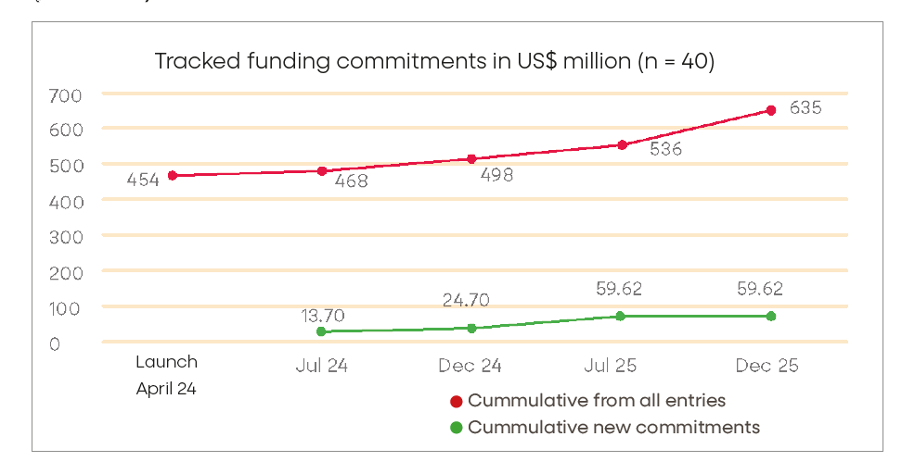
The total amount of funding from these 40 entries is USD 635.18 million. While that may sound like a lot, it is far from sufficient. When this sum is put in relation to the 500 million women and girls who lack the resources and support to manage their menstruation safely, hygienically and without shame, it equates to only 18 cents per person in need per year, or less than 2 cents per person in need per month.
<h3 class="heading-style-h6">Governments are stepping up, but funding remains narrowly focused</h3>
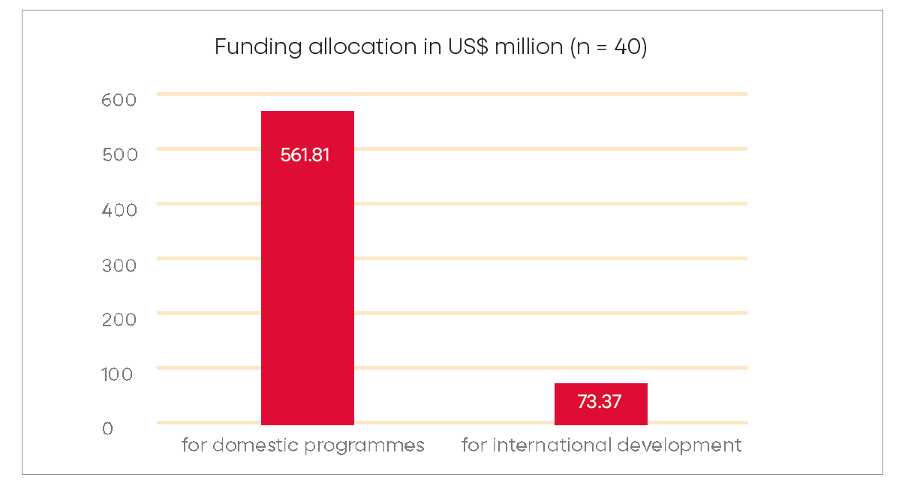
Domestic public funding is currently the most important source of financing for MHH, both in high and middle-income countries. Since the start of the MHH Funding Tracker, several countries have started new programmes and others have replenished their budgets, underlining increasing government commitment to MHH. Awareness raising and advocacy towards governments pays off. Funding is primarily for programmes providing free access to menstrual products in schools and universities, and - in some instances - for low-income households. Unfortunately, other critical aspects of MHH - period education, destigmatisation, health services and period-friendly WASH infrastructure - continue to be neglected.
<h3 class="heading-style-h6">Philanthropy and official development donors are largely absent</h3>
MHH receives very little funding from philanthropy and official development assistance, especially when compared to related issues such as contraception and gender-based violence.
<p id="a3"> </p>
<h2 class="heading-style-h4">What this means for funding and advocacy</h2>
Taken together, these findings highlight a clear imbalance: while awareness and government action are growing, overall funding remains far too low and unevenly distributed across critical areas.
Without a significant increase in both the volume and scope of funding, progress on menstrual health and hygiene will remain slow—and millions will continue to lack the support they need.
<p id="a4"> </p>
<h2 class="heading-style-h4">How to use the findings</h2>
<h3 class="heading-style-h6">National-level advocacy:</h3>
- Working to convince your government to start funding MHH? Increase the pressure by using the examples from the MHH Funding Tracker showing that other governments are already moving ahead.
- Is your government included in the MHH Funding Tracker? Fantastic! Use the data to push government to walk the talk, to advocate for replenishments and/or budget increases.
- Urge funders to earmark and track funding on MHH.
<h3 class="heading-style-h6">For global-level advocacy: </h3>
- Use the data to make the case for increased funding for MHH when talking to via-a-vis governments, philanthropic funders and multilaterals.
- Urge funders to earmark and track funding on MHH.
Access the latest data and insights to strengthen your advocacy and push for more – and better – funding for menstrual health and hygiene.
We need your help to expand and update the MHH Funding Tracker!
The more data points the MHH Funding Tracker has, the more helpful it becomes for advocates. Please support our efforts by sharing any information about funding commitments for MHH of USD 1 million and above that are not yet included with Ina Jurga, International Coordinator MH Day, at Ina.Jurga@wash-united.org

.png)
.png)